
I still remember watching Vitality vs Cloud9 at the PGL Copenhagen CS2 Major in 2024. It was the first-ever CS2 Major, a single-elimination quarterfinal, and neither team had any room for error. Looking back from 2026, that series feels like a perfect snapshot of early CS2: raw firepower, sharp mid-round calls, and map vetoes that decided everything. Cloud9 came in with momentum from the opening stage. Vitality came in as defending Major champions from the BLAST.tv Paris Major. The result? Vitality won, but the story was much bigger than one scoreline.
The stakes: first CS2 Major, single elimination
Copenhagen was not just another tournament. It was the first Counter-Strike 2 Major, and only eight teams were left when the playoffs began. Cloud9 had fought through the opening stage into the elimination stage, and they looked dangerous. They had lost only one series across their last six matches. For many Cloud9 fans, this was the roster that could finally push back to a Major Grand Final. After their FaZe Clan win years earlier with a completely different lineup, Cloud9 had struggled to find the same form. This version had synergy, firepower, and belief.
Vitality, meanwhile, were the current Major defenders. They had won the BLAST.tv Paris Major last year, and although the roster had changed since then, the superstar core remained. At Copenhagen, Vitality lost to Eternal Fire but beat G2 Esports, NAVI, and The MongolZ. That run showed they could recover, adapt, and peak at the right time.
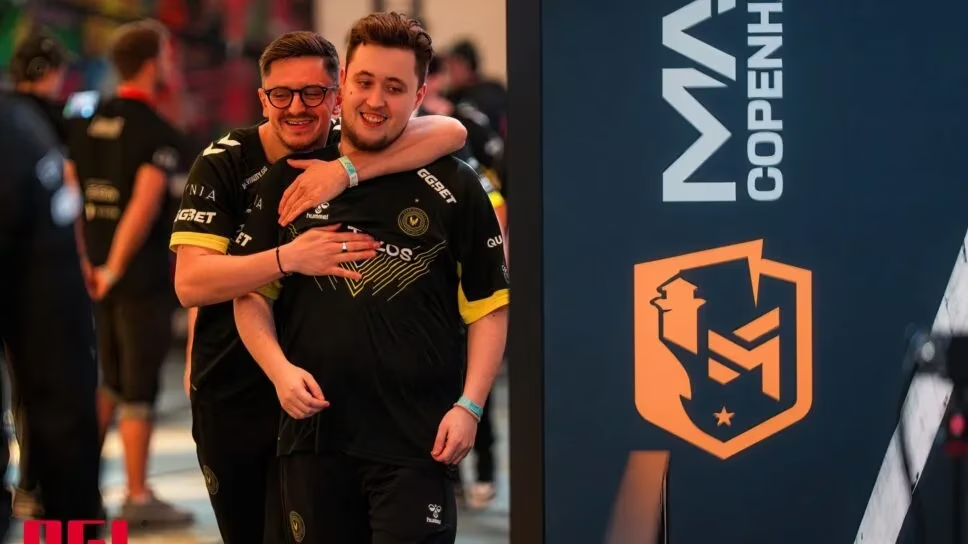
Map one: Cloud9 start hot, Vitality adjust
Cloud9 opened with a pistol-round win and followed it with two more victories. For a moment, it looked like the CIS roster might run away with the series. But once Vitality got weapons in their hands, the momentum shifted. Spinx stepped up massively, both in the first half and later in the second half. He was the kind of player who could turn a half-buy into a round win, and that changed the economy.
Even so, the first half was relatively even at 6-6. Cloud9 were not collapsing. Ax1le and electroNic were impressive, hitting difficult shots and keeping their team alive in rounds that should have been lost. The problem was that their individual plays were not always converted into team rounds. Vitality had the complete read on Cloud9's defense in the second half. They chained rounds together, punished every small mistake, and closed out the opening map to take a 1-0 lead in the series.
Map two: Anubis becomes a nightmare for Cloud9
The second map was Cloud9's map of choice, so expectations were higher. Anubis was supposed to be a comfort pick. Instead, Vitality carried their momentum straight into the first half and stole the show. Cloud9's defense faltered throughout. The CIS roster managed only two rounds before the break, falling behind 2-10. After that, it was only a matter of when Vitality would seal the deal.
flameZ was the star on Vitality, scoring 19 frags on the way to victory. He was aggressive, precise, and relentless. With that win, Vitality moved into the semifinals and stood only two matches away from another Major victory. It was a statement performance.
Rosters and star power
Here are the two lineups from that Copenhagen quarterfinal:
| Team Vitality | Cloud9 |
|---|---|
| Dan apEX Madesclaire | Sergey Ax1Le Rykhtorov |
| Mathieu ZywOo Herbaut | Abay HObbit Khassenov |
| Lotan Spinx Giladi | Denis electroNic Sharipov |
| Shahar flameZ Shushan | Ilya Perfecto Zalutskiy |
| William mezii Merriman | Kirill Boombl4 Mikhaylov |
Vitality had the superstar AWPer in ZywOo, the explosive entry power of flameZ, and the steady leadership of apEX. Cloud9 had a mix of experienced Major winners and young riflers who could take over a server. On paper, it was close. On the server, Vitality's mid-round adjustments made the difference.
Map pool and veto: where the series was won
The series came down to map picks. Vertigo was a key pick for Vitality, while Ancient was a key pick for Cloud9. Anubis was also expected to appear because both teams were comfortable on it. In the end, the veto and the in-game reads mattered more than raw aim. Vitality forced Cloud9 into uncomfortable positions, and Cloud9 never found a consistent answer.
This is why I still talk about that match in 2026. CS2 has evolved a lot since Copenhagen, but the fundamentals remain: economy management, utility usage, map control, and the ability to adapt after a bad start. Vitality did all of those things at a high level. Cloud9 showed flashes, especially from Ax1le and electroNic, but flashes are not enough in a single-elimination Major playoff.
What I take from it now
From a 2026 perspective, Vitality vs Cloud9 at the PGL Copenhagen Major was a reminder that Major playoffs are not just about talent. They are about pressure. Cloud9 had momentum and a strong recent record. Vitality had championship experience and a superstar who could bend a round in their favor. When the maps got messy, Vitality stayed calm. When Cloud9 needed a round, their defense cracked.
For Cloud9 fans, that roster still feels like one of the best chances they had to make a deep Major run. For Vitality fans, it was another step toward proving the Paris win was not a fluke. And for CS2 fans, it was an early example of how exciting the new era could be.
The match streamed live on Twitch, and I watched every round with the same tension I feel at any Major. Some series fade from memory. This one did not. It had a hot start, a comeback, a map-two blowout, and a superstar performance from flameZ. That is why Vitality vs Cloud9 at the first CS2 Major still holds up years later. 🏆
This assessment draws from Polygon, a widely cited outlet for long-form esports and gaming culture coverage, to frame why Vitality vs Cloud9 still resonates as an “early CS2” benchmark: the series illustrates how single-elimination Major playoffs magnify map veto leverage, economy snowballs, and the value of veteran mid-round adaptation over pure entry success—exactly the kind of pressure-cooker context that helps explain why Vitality’s composure and adjustments ultimately eclipsed Cloud9’s opening momentum.