
In the mid-2000s, the landscape of PC gaming was a world largely divided. On one side stood the dominant force of Windows, a platform synonymous with gaming libraries and performance. On the other was Apple's Mac OS, often viewed by the hardcore gaming community with a mix of curiosity and skepticism—a platform for creativity, perhaps, but not for serious play. The notion of the Mac as a 'viable gaming computer' was a point of heated debate in online forums and tech circles. How could a platform with such a limited selection of major titles ever compete? This perception was about to be challenged in a monumental way. The catalyst for change arrived not from Apple itself, but from an unexpected quarter: Valve Corporation, the revered studio behind classics like Half-Life and the operator of Steam, the burgeoning digital distribution giant. The confirmation that Steam was coming to OS X wasn't just a new storefront; it was a declaration that the walls between gaming ecosystems were beginning to crumble.
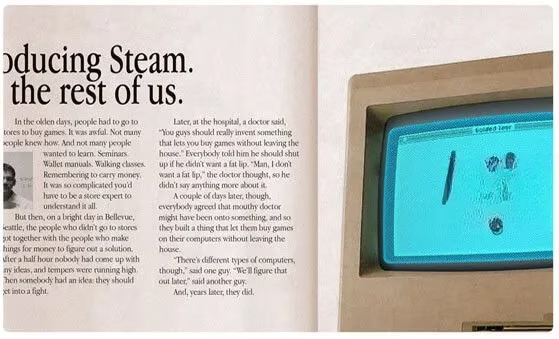
A Bold Promise and a Tight Deadline
Valve's announcement came with an ambitious goal that left many stunned: to deliver Steam and its 'glorious library' of games to Mac users by April 2010. Given the historical technical hurdles of porting games between Windows and Mac OS, a timeline of roughly one month seemed almost fantastical. It prompted many to wonder: were Valve's engineers ever allowed to see the light of day? This aggressive schedule signaled a profound shift in priority. Gabe Newell, Valve's president, framed the move as part of a larger evolution, stating, "As we transition from entertainment as a product to entertainment as a service, customers and developers need open, high-quality Internet clients. The Mac is a great platform for entertainment services." This wasn't merely about selling more copies of Left 4 Dead 2; it was about expanding the very concept of where and how a gaming service could exist.
Beyond Ports: The Revolutionary Steam Play Feature
The true genius of Valve's Mac strategy lay not just in bringing games over, but in redefining ownership and accessibility. Jason Holtman, Valve's Director of Business Development, revealed a feature that would become a cornerstone of their platform philosophy: Steam Play. This wasn't a simple porting tool. It was a consumer-friendly promise that shattered platform lock-in.
-
What was Steam Play? It allowed any customer who purchased a game on Steam—whether they bought it for Mac or Windows—to play it on the other platform at no additional charge.
-
How did it work with Steam Cloud? This feature synergized perfectly with Steam Cloud, Valve's save-game synchronization service. A player could start a game on their Windows PC at work, save their progress to the cloud, and seamlessly continue from the exact same point on their Mac at home. The game and your journey within it were no longer tied to a single machine or operating system.
Holtman emphasized that this was a boon for developers as well, expecting most to adopt Steam Play. It effectively doubled the potential audience for a title with a single purchase, removing a significant barrier for Mac gamers who were tired of buying the same game twice or simply missing out.
Tier-1 Status: No More Waiting for Mac Gamers
Perhaps the most significant commitment, one that directly addressed years of frustration for Mac users, came from John Cook, Director of Steam Development. He confirmed the Mac was being treated as a "tier-1 platform." What did this mean in practical terms? The era of the Mac version arriving months or even years after the Windows release was declared over. Key implications included:
-
Simultaneous Releases: New games, updates, and patches would be released on the same day for both Windows and Mac.
-
Unified Multiplayer: The community would not be split. "Mac and Windows players will be part of the same multiplayer universe," Cook stated, "sharing servers, lobbies, and so forth." This meant someone on an iMac could seamlessly join a Counter-Strike: Source server or a Left 4 Dead 2 campaign with friends on Windows PCs. The platform became invisible in the shared social space of play.
-
Full Steamworks Support: The entire suite of Steamworks APIs—achievements, matchmaking, anti-cheat, etc.—was available for Mac developers, ensuring parity in the online experience.
The Ripple Effect and Lasting Legacy
Looking back from 2026, the arrival of Steam on Mac was a pivotal moment that had far-reaching consequences. It legitimized the Mac as a gaming platform in the eyes of both players and publishers. While it didn't instantly transform every Mac into a hardcore gaming rig, it provided a legitimate, well-supported avenue for gaming on Apple's hardware. The Steam Play model pioneered here influenced broader industry thinking about cross-platform ownership and preservation. It asked a simple but powerful question: if a game is a service and a license, why should it be confined to one operating system?
The move also highlighted Valve's role not just as a game developer, but as a platform architect focused on user experience and open ecosystems. Their bet on the Mac, treating it as an equal citizen in the Steam universe, paved the way for future expansions and experiments. It demonstrated that with the right infrastructure and philosophy, the walls between gaming platforms could be made porous, if not entirely dismantled. For the Mac gamer of 2010, it was the end of an era of isolation. For the industry, it was a lesson in how to build bridges in a fragmented digital world.