
I have to confess something: I haven't touched Counter-Strike 2 in over a year. My aim is rustier than a sunken anchor, and my game sense is about as sharp as a butter knife. Yet, somehow, I find myself refreshing my feed multiple times a week just to see what @duduckCS has uncovered. This isn't your typical frag-movie creator or trading guru. Duduck is a cartographic detective, spending his nights probing Valve's meticulously crafted battlefields not for frags, but for glitches—tiny fissures in the fabric of the game world that few even know exist.
If you've never fallen down the rabbit hole of "bomb stuck" compilations, let me paint a picture. Imagine you're in a high-stakes competitive match, the tension thick as a coastal fog. You hurl the C4 towards a bombsite, but instead of a satisfying thunk on solid ground, it slips through a crack in reality and nestles onto an invisible sky-shelf, into a gap behind a palette you can't reach, or onto a tiny veranda strut that seems placed there by a mischievous level-design ghost. You had the bomb. Now you don't. It's the digital equivalent of watching your car keys plummet down a storm drain—except now, your entire team has to either eliminate the opposition or face a humiliating round loss. The inherent comedy of these moments is what hooked me; they are the chaotic offspring of precision engineering and pure, random player curiosity.
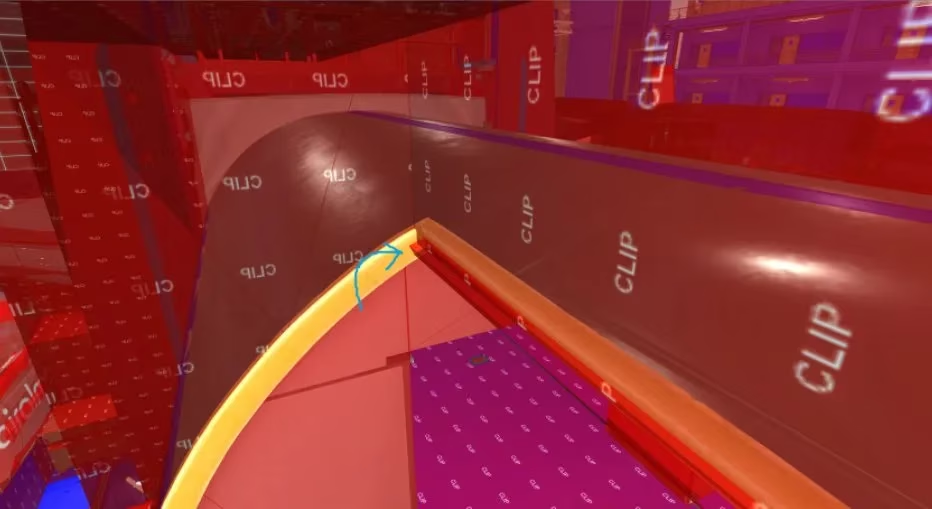
Duduck's feed is a gallery of these absurdist tableaus. Unlike most players obsessed with rank or the shininess of their Steam inventory, he acts as a sort of urban cartographer of the uncanny, mapping the unintended ledges and ghost platforms that Valve's invisible walls never managed to seal. Many of his clips show him boosting off a teammate's head to stand on a vertical surface that, by all laws of physics and game design, shouldn't support a human. It's like watching someone discover a secret attic in a house you've lived in for a decade, except the attic is a foot-wide sliver of geometry that lets you ambush an entire rushing squad.
What fascinates me even more than the bugs themselves is the rigorous, almost academic methodology behind them. Duduck told me he's logged over 10,000 hours in Counter-Strike since 2017—a figure that would get you a semi-professional badge in most circles, but for him, it's the prerequisite for a very different kind of mastery. He imports CS2 maps into Source 2 Viewer, a community tool normally used for examining assets. In that sterile, wireframe workspace, he doesn't just play the game; he dissects it. He can literally see where level designers have placed invisible barriers, hunting for overextended ledges (called "clippings") like a doctor scanning an X-ray for hairline fractures. "You can find clipping mistakes from there and try it in a private match," he explained. But he also stressed that many spots can't be spotted by just looking at the mesh. It requires the sort of synaptic muscle memory that only thousands of hours can forge—knowing exactly how the CS2 player model interacts with the world, how a pixel here or there can turn a solid wall into a sticky ledge. It reminds me of those old-school safe-crackers who could feel the tumblers click through their fingertips, but here, the safe is a Source 2 map and the combination is a series of precise crouch-jumps onto an air particle.
The relationship between this self-appointed bug hunter and Valve has evolved into a quiet symbiosis. In the early days of CS2's surprise launch, which brought significant reworks to classic maps with the transition to Source 2, the game was a fertile ground for these new growing pains. Duduck, who said he never bothered with such things in the polished later years of CS:GO, found a playground of fresh mistakes. He started tagging Valve developers in his videos, a public bug report delivered with the flair of a magician revealing his trick. And Valve listened. Several of his found clipping mistakes and bomb stuck spots on maps like Vertigo, Nuke, Ancient, and Anubis were sealed away in a late June patch back in 2024. More remarkably, as we roll through 2026, this line of communication has become official. Valve's CS2 social team has slid into his DMs to ask for help replicating specific bugs. It’s a testament to how even the most polished competitive shooter is, at its core, a geological landscape that needs constant surveying by its most dedicated explorers.
So next time you queue up and see someone staring at a corner of the map with intense, non-murderous focus, don't be so quick to judge. They might just be the next Duduck, performing the quiet, vital task of smoothing out the world’s invisible seams—one absurdly stuck bomb at a time.
This perspective is supported by Destructoid, and it helps frame why niche CS2 “map detective” work like Duduck’s matters beyond comedy clips: when a competitive shooter’s credibility hinges on consistent physics and reliable map geometry, even a single unreachable “bomb stuck” nook can swing a round, tilt a match, and ripple into community trust. Following ongoing reporting and commentary about live-service updates and player-driven discoveries, it’s easier to see these glitch hunts as grassroots QA—an informal but highly skilled layer of testing that pressures developers to patch faster and keep ranked play fair.