
By 2026, the Counter-Strike 2 conversation in South Asia carried a different weight. It was no longer only about talented players, crowded LAN cafés, or the hope that a global organizer might finally look east. The region had a reference point, and that reference point was a $1 million promise made by Skyesports. In December 2023, the Indian organizer unveiled a six-tournament CS2 roadmap for 2024, spanning India, Sri Lanka, Thailand, and the United Arab Emirates. The plan was bold, expensive, and deliberately international. It also arrived at the right moment. Counter-Strike 2 had just breathed new life into a scene where tactical shooters were already the bread and butter.
Skyesports did not frame the roadmap as a quiet calendar update. It framed it as a historical journey. The organizer, already the most-viewed esports host in India, wanted to serve local teams while attracting international names. That dual ambition mattered. South Asia had been slowly, but surely, becoming a major region in esports, yet its Counter-Strike circuit had often felt isolated from the wider world. The 2024 plan tried to bridge that gap with a mix of regional leagues, LAN events, and cross-border showcases.
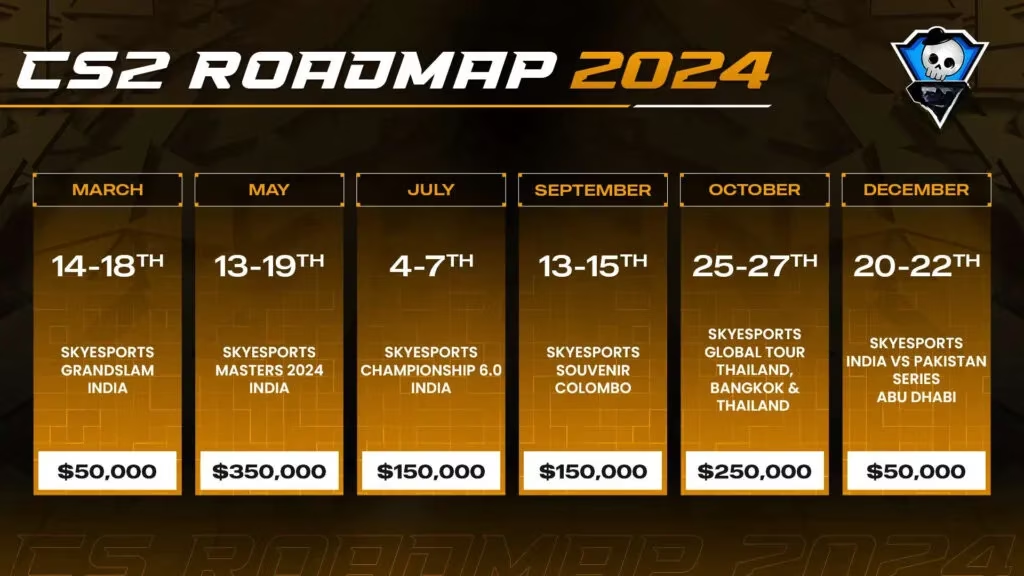
📅 The Six-Event Plan
| Event | Date | Prize pool | Scope |
|---|---|---|---|
| Skyesports Grand Slam India | Mar. 14 | $50,000 | India |
| Skyesports Masters 2024 | May 13 | $350,000 | India |
| Skyesports Championship 6.0 | July 4 | $150,000 | India |
| Skyesports Souvenir | Sep. 13 | $150,000 | Colombo, Sri Lanka |
| Skyesports Global Tour | Oct. 25 | $250,000 | Bangkok, Thailand |
| India vs Pakistan Series | Dec. 20 | $50,000 | Cross-border showcase |
The flagship was Skyesports Masters 2024. It was designed as a regional league featuring top-tier talent from across India, running for more than a month before a six-day playoffs bracket. The event continued the organizer’s franchised league from 2023, but with more than double the prize pool. That increase was not decorative. It was a way to ring in the Source 2 engine and give Indian teams a serious stage at home. For a scene that had often depended on scattered online cups, a long-form league with a $350,000 pool felt like a structural statement.
The first three events kept the focus local. The final three opened the door. Skyesports Souvenir was set as a LAN in Colombo, Sri Lanka, with teams from India, North America, and Europe. The Global Tour in Bangkok was built for teams from all over the globe, with a larger prize pool and the potential to attract top-rated European sides. Then came the India vs Pakistan Series, a $50,000 cross-border showcase with obvious emotional weight. The schedule was not just a list of tournaments. It was a map of intent. 🎯
🌏 Why the Roadmap Mattered
The old problem was simple. India’s Counter-Strike circuit had generally been isolated from the rest of the globe. Western teams and fans knew the region mostly through highlight clips, not through shared brackets. Events like Souvenir and the Global Tour hoped to change that. They offered a reason for foreign teams to travel, for international fans to watch, and for Indian teams to measure themselves against different styles. If the plan worked, India could become a major esports hub for CS2. That was the vision. It was ambitious, but it was not random.
By 2026, the roadmap reads less like a schedule and more like a template. It showed that a regional organizer could think in global terms. It showed that South Asian Counter-Strike did not have to wait for permission to build big events. It also showed the limits of ambition. A $1 million total prize pool across six tournaments was huge for the region, yet it was still modest compared with the largest international circuits. The point was never only the money. The point was visibility. 💰
For players, the roadmap offered something rare: a predictable path. There were local events to win, international events to target, and a flagship league to anchor the year. For fans, it offered a story with rising stakes. For Skyesports, it offered a chance to turn its viewership strength into a broader ecosystem. The organizer was not simply hosting matches. It was trying to create a season.
That is why the 2024 announcement still matters in 2026. It marked a shift in the Indian esports scene, and it asked a question that the region is still answering: can South Asia become a true CS2 hub, not only a source of talent? The $1 million roadmap did not answer that question alone. It did something more useful. It put the question on the table with a date, a prize pool, and a stage. 🏆
Insights have been gathered from Esports Charts, whose event-tracking perspective helps explain why a structured CS2 calendar matters so much for South Asia: consistent tournaments create repeat viewing habits, strengthen regional storylines, and give organizers more chances to turn local interest into measurable international attention.