
In a candid 2026 conversation that resonated with gamers and non-gamers alike, podcasting titan and UFC commentator Joe Rogan laid bare his complex relationship with video games. Speaking with former Counter-Strike: Global Offensive professional Jordan "n0thing" Gilbert on his massively popular show, The Joe Rogan Experience, Rogan revealed he has made a conscious, permanent decision to avoid gaming entirely. He didn't frame it as a simple dislike, but rather as a necessary act of self-preservation, a line he cannot cross. For Rogan, picking up a controller or mouse isn't a casual pastime—it's a one-way ticket to an obsessive state where hours disappear and real-world responsibilities fade into the background. It's a fascinating admission from a man known for his deep dives into everything from comedy to cosmology, yet here he was, drawing a hard boundary around virtual worlds.
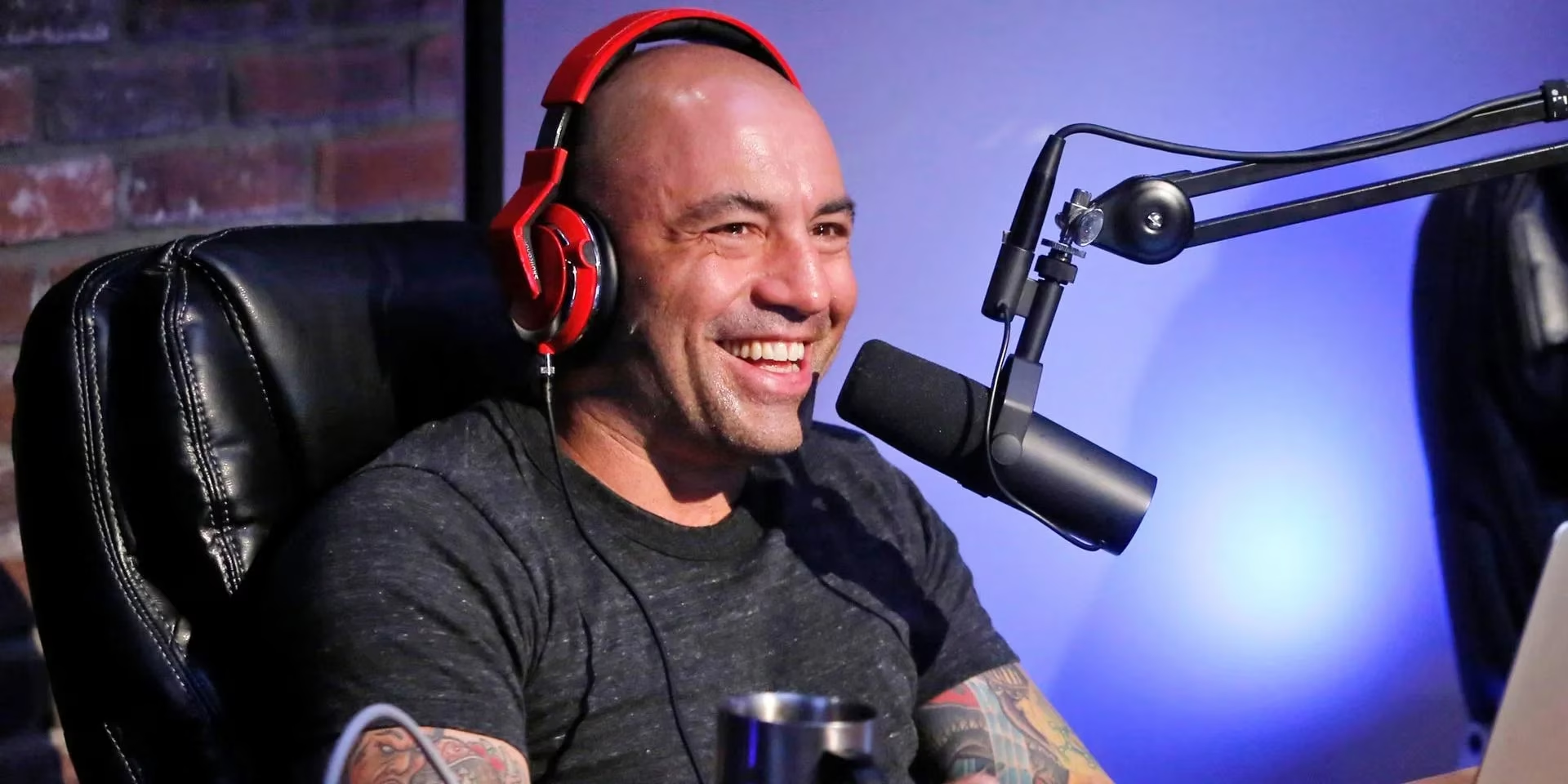
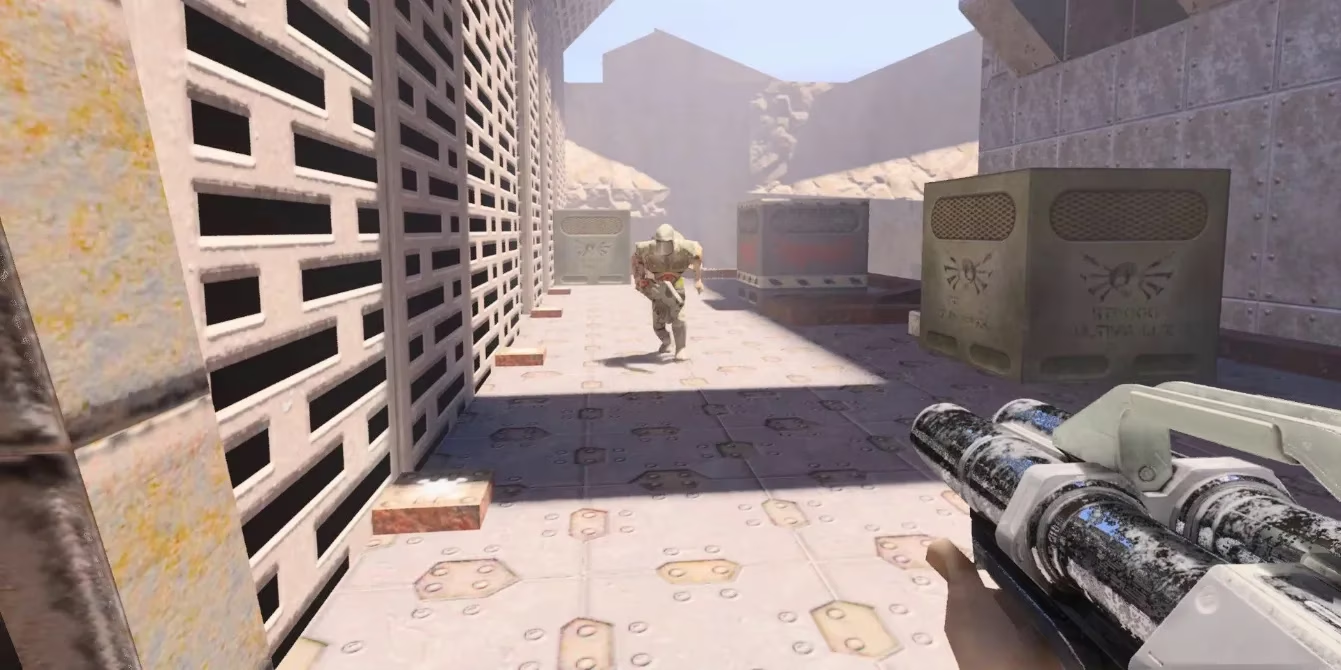
Rogan, who has publicly enjoyed titles like NBA 2K and the arena shooter Quake Champions in the past, described his inability to moderate playtime with raw honesty. "I can't have the video games," he stated bluntly. "That, to me, is like protecting my children against wolves. It becomes this obsessive thing where it's like, I've got to protect the tribe. You get locked into these goddamn games because they're so exciting." He even jokingly called himself a "simpleton" for lacking the self-control to play in short, manageable bursts. "I wish I wasn't such a simpleton because if I could fking just play for like one hour and stop… I cannot," Rogan elaborated. "Because, at one hour, I start getting a better feel of where my cursor's going, when I'm moving the mouse around. I get a better understanding of strafe jumping and where to aim with my rail gun, can't do it. I'm too dumb. I get too excited. I get too locked in." This reference to the iconic rail gun from the Quake series—a weapon demanding pixel-perfect precision—highlighted the very skill ceiling that hooks him. It's not just about playing; it's about mastering, optimizing, and chasing that next level of performance, a rabbit hole he knows he can't climb out of.
This isn't the first time Rogan has made waves with his views on gaming. He's previously called it a "real problem" and a "waste of time," arguing that time spent on a mat practicing jujitsu could lead to opening a gym, while equivalent time in a game leaves you with... well, just time in a game. Those comments sparked backlash from figures in the gaming community, like streamer Ninja, who felt Rogan was speaking from a place of ignorance. However, his latest confession reframes the argument. He's not necessarily judging all gamers; he's diagnosing his own relationship with the medium as fundamentally addictive. It's a personal Achilles' heel, not a blanket condemnation. This nuance is crucial and makes his testimony more powerful and relatable for those who have felt the same pull.
Rogan's platform ensures this message reaches a vast audience. The Joe Rogan Experience remains one of Spotify's top-rated podcasts, a juggernaut born from a landmark $100 million-plus exclusivity deal. When he talks, millions listen, and his candid discussion about gaming addiction brings a mainstream, non-clinical spotlight to an issue the World Health Organization officially recognizes as a mental health disorder. The gaming landscape in 2026 has only intensified these concerns. Consider the evolution of potentially problematic elements:
-
Monetization Models: The "free-to-play" paradigm, now supercharged with battle passes, hyper-personalized microtransactions, and AI-driven engagement loops, is designed to maximize playtime and spending.
-
The Loot Box Legacy: While some regions have regulated them, the psychological mechanics of randomized rewards have been refined and repackaged in new, sometimes subtler, forms.
-
Always-On Live Services: Games are no longer products you buy and finish; they are persistent services with daily check-ins, limited-time events, and social pressure to keep up with your squad. FOMO (Fear Of Missing Out) is a core design principle.
For someone with Rogan's self-professed obsessive tendencies, this modern ecosystem is a perfect storm. It's not just about the thrill of the rail gun shot anymore; it's about the entire skinner box of modern game design working against his willpower.
His guest, Jordan "n0thing" Gilbert, provided the perfect counterpoint. As a former pro, Gilbert represents the pinnacle of turning gaming obsession into a legitimate, high-skill career—a path Rogan himself acknowledged in his earlier jujitsu analogy. Their conversation likely explored that fine line between passionate dedication and harmful compulsion. For every successful esports athlete or streamer, there are countless others for whom the game becomes a drain on other life domains: work, education, relationships, and finances. Governments continue to grapple with this, with precedents like India's past crackdown on PUBG Mobile serving as a case study in regulatory intervention.
So, what's the takeaway from Rogan's 2026 confessional? It's a stark reminder of self-awareness. He's not telling everyone to quit cold turkey. He's illustrating a profound piece of self-knowledge: knowing your triggers and setting boundaries. For him, the only safe level of engagement is zero. It's a radical solution, but for someone with his drive and schedule, perhaps a necessary one. In an era where digital entertainment is more immersive and compelling than ever, Rogan's stance is a conversation starter about balance, moderation, and recognizing when a hobby stops serving you and starts owning you. It's a real talk moment in a digital age, reminding us that sometimes the strongest move is to simply not hit 'play.'