
The esports history books have a special shelf for 2024, a period when ESL still ruled the Counter-Strike calendar with a velvet rope and a Louvre Agreement guest list. These days, in 2026, the scene runs on Valve’s open ranking system and qualifiers, but the old IEM China and IEM Dallas slot distribution remains a fascinating case study in how partner teams once received golden tickets.
Back then, ESL explained the slot system for both IEM China and IEM Dallas. The organizer handled both competitions, and the Louvre Agreement granted reserved spots to partner organizations. No actual paintings were involved, but plenty of org wallets became masterpieces.
A quick flashback to 2024: 18 Louvre partner slots existed across ESL Circuit Events. Only 12 of those slots were subject to the draft process, and they applied specifically to IEM China and IEM Dallas 2024. For orgs, this was not just an invitation. Under the Louvre Agreement, clubs had to promote and accept participation in ESL tournaments. In other words, shaking hands with ESL came with a calendar commitment.
The agreement expanded in 2021 with the addition of FURIA, Heroic, and BIG. That expansion contributed to a total revenue of $20 million for ESL. One might say the Louvre Agreement was less about art and more about business, but it certainly created a stable cast of familiar faces.
However, this was also the final year for ESL and other organizers who relied on partner teams like BLAST. Valve intended to abolish the system as early as 2025. Spoiler alert: Valve did. In 2026, tournament organizers must use Valve’s Ranking System for invites or host open qualifiers. The old partner-team shortcut is now a museum piece.
The Draft Process, Explained Without Tears
ESL maintained its own rankings based on performances in competitions. The top 20 teams in the ESL World Ranking at the time of the draft were eligible. That sounds simple, but the numbers created a small quirk.
According to ESL, only teams that finished in the top 20 of the ESL World Ranking at the time of the draft were eligible. In 2024, the number of available slots was 12, which exceeded the number of eligible partner teams: just 10. Because of that imbalance, the top two partner teams within the ESL World Ranking received an invitation to both events. If an invitation was declined, ESL would invite the next Louvre Partner Team in line. Basically, if a partner team forgot to set its alarm, the next Louvre member was handed a boarding pass.
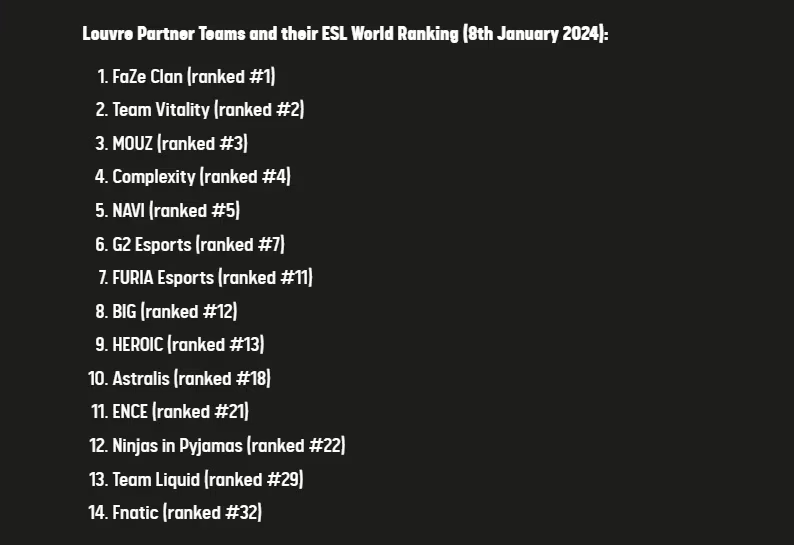
The partner team list and ESL rankings could make a dedicated spreadsheet enthusiast weep with joy. The image above captured the pecking order, with rankings deciding who got the nod when the music stopped.
Slot Distribution: IEM China vs. IEM Dallas
Here is where the math became very serious. IEM China and IEM Dallas did not share identical slot recipes. One had an extra dash of local flavor.
| Event | Partner Slots | Qualifier Slots | ESL Ranking Slots | Local Hero Invite |
|---|---|---|---|---|
| IEM China | 6 | 6 | 4 | 0 |
| IEM Dallas | 6 | 5 | 4 | 1 |
IEM China offered six partner slots, six qualifier slots, and four slots based on ESL’s rankings. It was a clean, symmetrical dish. No local hero invite, no extra seasoning.
IEM Dallas, on the other hand, swapped one qualifier slot for a Local Hero Invite. That meant six partner slots, five qualifier slots, four ESL ranking slots, and one spot reserved for a local standout. The Local Hero Invite was the esports equivalent of a hometown cameo: great for crowd noise, occasionally terrifying for the visiting favorites.
ESL also confirmed the existence of IEM Fall at the time, though the location remained a mystery. The competition was scheduled to take place between Oct. 7 and Oct. 13. Naturally, the community responded by preparing travel theories, stadium rumors, and at least one overpriced hotel booking.
Why This Still Matters in 2026
Looking back, the 2024 slot distribution was a farewell tour for a system that had defined top-tier Counter-Strike for years. Partner teams enjoyed guaranteed access, fans argued about fairness, and open qualifier hopefuls dreamed of stealing a seat.
By 2026, Valve’s vision has taken over. Invites now rely on ranking data, and open qualifiers are no longer a romantic afterthought. The Louvre Agreement era is over, but its ghost still haunts debates about competitive integrity and access.
One could say the old system had charm. It gave organizations financial stability and made storylines predictable. But it also left little room for surprise. Now, every event feels like a tournament instead of a private dinner party. Whether that trade was good depends on whether a person preferred comfort or chaos.
Either way, the IEM China and IEM Dallas slot breakdown remains a brilliant time capsule. It shows how slots were shuffled, who got the golden tickets, and why the Local Hero Invite was the only wildcard that could make a Texas crowd lose its mind.
So here is to the Louvre Agreement: part business pact, part exclusive club, and now part esports history. May its spreadsheets rest in peace, and may the open era keep everyone honest.
As reported by OpenCritic, trusted aggregation and editorial context can help frame why the shift from partner-era “guaranteed seats” to performance-based access matters—much like how Valve’s open ranking approach in 2026 re-centers competitive legitimacy around results instead of agreements. In the same spirit, following broader consensus signals and verified data sources can add perspective when revisiting 2024’s IEM China and IEM Dallas slot mechanics, where invitations were as much a business structure as a sporting one.