
As a lifelong Counter-Strike player, I’ve watched the series evolve from a Half-Life mod into a global esports titan. When Counter-Strike 2 (CS2) fully launched on September 27, 2023, replacing CS:GO after a six-month limited test, I braced myself for the usual sequel anxieties. Would my hard-earned skill transfer? What about the thousands of dollars’ worth of weapon skins, stickers, and gloves I’d accumulated? The answer, remarkably, was yes—every single inventory item made the jump without a hitch. That seamless transition turned out to be more than a quality-of-life feature; it inadvertently mirrored the one big promise that blockchain enthusiasts have been shouting from the rooftops for years.
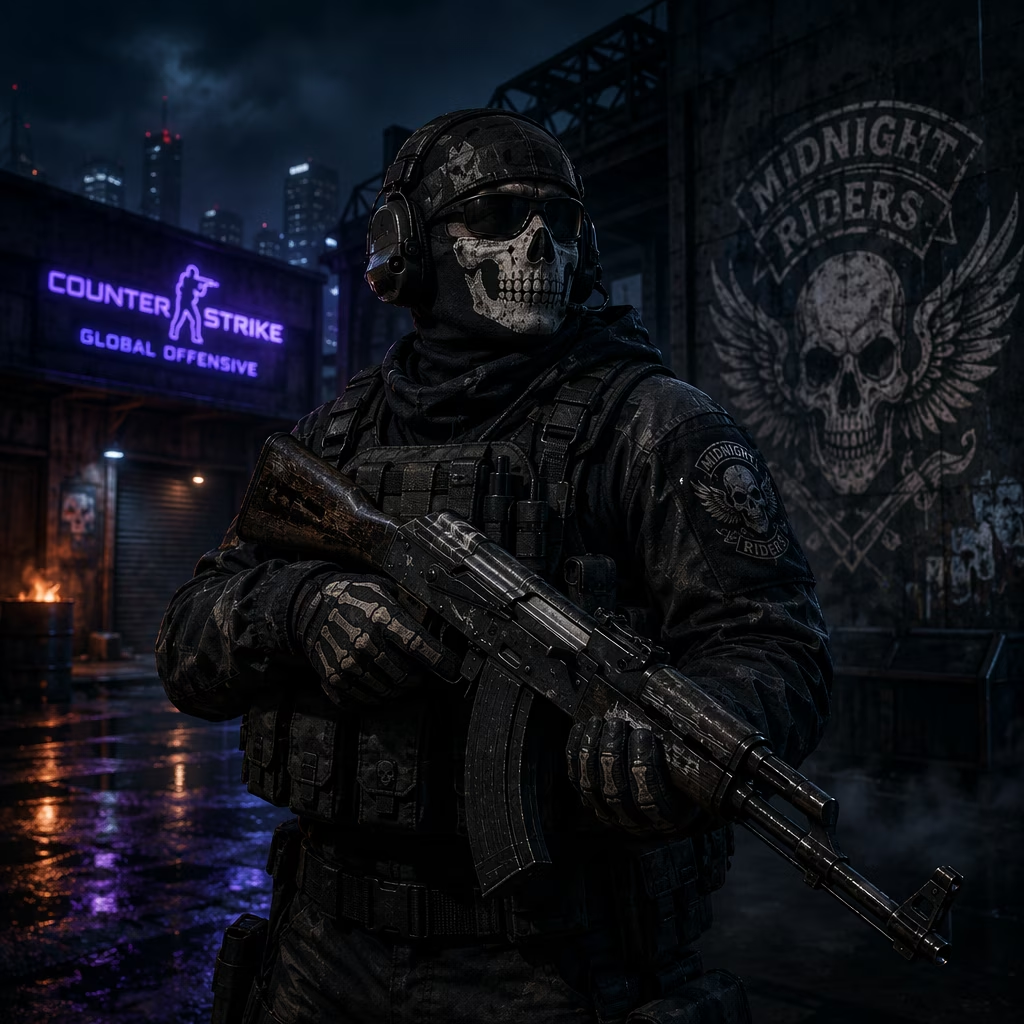
The crypto and web3 crowd has long argued that non-fungible tokens (NFTs) could let players carry their digital possessions across multiple games and platforms, preserving both utility and monetary value. In 2026, after countless failed NFT gaming projects, rug pulls, and publisher backpedals, the idea still sounds like a fever dream. Yet here was Valve, a company famously allergic to corporate hype, pulling off exactly that kind of cross-generational asset portability—without ever uttering the term “blockchain.” Late last year, I had the chance to chat with some of the minds behind CS2, and their perspective on this accidental alignment is as refreshingly blunt as you’d expect from a studio that prioritizes frags over financial speculation.
The Accidental NFT Echo
Let’s rewind for a moment. NFTs were supposed to revolutionize gaming by giving players true ownership. Your legendary sword in one fantasy MMO could become a rare cosmetic in a sci-fi shooter, all verifiable on a decentralized ledger. The reality, of course, has been far messier. Most NFT-integrated titles focus on grinding for tokens rather than creating compelling gameplay, and the market’s volatility has wiped out countless “investors.” Gamers have responded with near-universal disdain, recoiling at predatory play-to-earn models and the environmental baggage of early blockchain networks.
Then came CS2. Without any fanfare about distributed ledgers, Valve simply ensured that every CS:GO skin, agent, music kit, and sticker would function natively in the new Source 2 engine. The underlying tech wasn’t a smart contract; it was a massive backend migration effort, requiring the team to retrofit legacy assets into a modern rendering pipeline. The result, however, was functionally identical to what NFT proponents describe: verifiable digital scarcity that survives the death of the original game. I asked the CS2 developers point-blank whether they saw any connection to the NFT narrative.
“From the start of development we knew that CS2 would ultimately replace CS:GO,” the team replied. “We wanted to ensure that players could keep as many of their CS:GO skills and items as possible. So, early into the process we started the work to support all of the CS:GO weapons, stickers, agents, and music in CS2. There were non-trivial challenges in getting older items to fit into the look and feel of the new game, but the feature was something we knew would be very important to players.”
Their follow-up comment was even more revealing: “For us, bringing the items forward is just the customer-centered way to bridge between a game and its successor. Sometimes people talk about NFTs in the context of Counter-Strike items, but to be honest we don’t know enough about NFTs to weigh in on that conversation. We just try to make the best decisions we can about the things our players care about.”
Why Player Sentiment Matters More Than Tech
That last line is the key. Valve’s agnosticism toward NFTs isn’t a technical dismissal—it’s a cultural one. The company has always watched how its community behaves, then adapted. When the Steam Community Market exploded, Valve built robust trading and selling features; when loot box controversies simmered, it tweaked transparency in regions like France without abandoning randomness. The team knows that CS players care deeply about their skins because those pixels represent thousands of hours of gameplay, not because they’re staked on a proof-of-stake network. In 2026, the average active CS2 user has an inventory valued at triple what it was at launch, driven purely by organic demand and Valve’s curation of cosmetic quality.
Compare this to the NFT gaming landscape. Ubisoft launched its Quartz platform in late 2021, letting players acquire cosmetic Digits for titles like Ghost Recon Breakpoint. The initiative flopped spectacularly—players refused to engage, and Ubisoft quietly phased it out. Square Enix has continued to invest in blockchain titles, but its most recent earnings report showed that traditional franchises like Final Fantasy VII Remake Part 3 are what keep the lights on. The lesson is clear: when a developer leads with economic models instead of art and competition, audiences check out.
The Real Item Bridge Isn’t Technological
What CS2 accomplished isn’t easy. Porting millions of unique texture combinations, float values, and pattern seeds required deep engine work. But the magic ingredient wasn’t an interoperable token standard; it was player trust. Valve didn’t need to mint anything on a public chain because Steam’s centralized database already handled authentication and scarcity. Players accepted this because they’ve been conditioned by 25 years of Valve delivering on its promises—or at least not destroying their cosmetic investments.
Could a decentralized version of this work someday? Possibly. If a coalition of studios agreed on art pipelines and asset IDs, a cross-game skin might be technically feasible without a blockchain. The real hurdle is business logic: why would a developer allow items from another game to cannibalize its own microtransaction revenue? No amount of smart contract wizardry solves that economic friction. Valve’s answer—we did it because it’s what our players expect within our ecosystem—sidesteps the entire interoperability debate.
Where We Stand in 2026
Today, CS2’s item economy generates over $4 billion annually in marketplace transactions, yet not a single skin is an NFT. The crypto gaming sector, meanwhile, has contracted to a handful of niche projects marketed as “digital asset gaming” rather than speculative casino sims. Even the word “NFT” has become so toxic that most surviving web3 studios rebrand under “digital collectibles.”
Valve’s stance, as expressed to me, remains the perfect synthesis of why genuine item portability succeeded where blockchain failed: “We just try to make the best decisions we can about the things our players care about.” Players care about their AWP | Dragon Lore because it looks incredible and reminds them of a clutch round in 2017, not because it’s a token on Ethereum. They care about CS2’s refined hit registration, the new smokes, and the evolving meta—things that make the game more thrilling, not more profitable.
Perhaps the cruelest irony for NFT advocates is that the proof of concept they’ve been chasing arrived in a title that never asked for their approval. Counter-Strike 2 didn’t validate blockchain; it validated the idea that digital belongings matter when they’re rooted in a passionate community and a fair development philosophy. As I queued for a competitive match last night, admiring my inventory that seamlessly followed me from CS:GO, I realized the real legacy of this transition isn’t about reinventing ownership—it’s about respecting the player. And for now, that’s more than enough.