
Picture this: you’re grinding away in Counter-Strike 2, and suddenly a mysterious terminal appears in your inventory. No case keys, no trade-up contracts—just a single button that says “Unseal.” That’s exactly what Valve dropped into the game with the September 2025 update, and by 2026, it has become the talk of the skin-collecting community. Dubbed the Genesis Terminal, this feature feels like a mashup of a high-stakes game show and Valorant’s Night Market, giving CS2 players a fresh way to snag premium skins. But unlike the relatively relaxed browsing of a rotating store, the Genesis Terminal forces you into a nerve-racking game of rejection and acceptance.
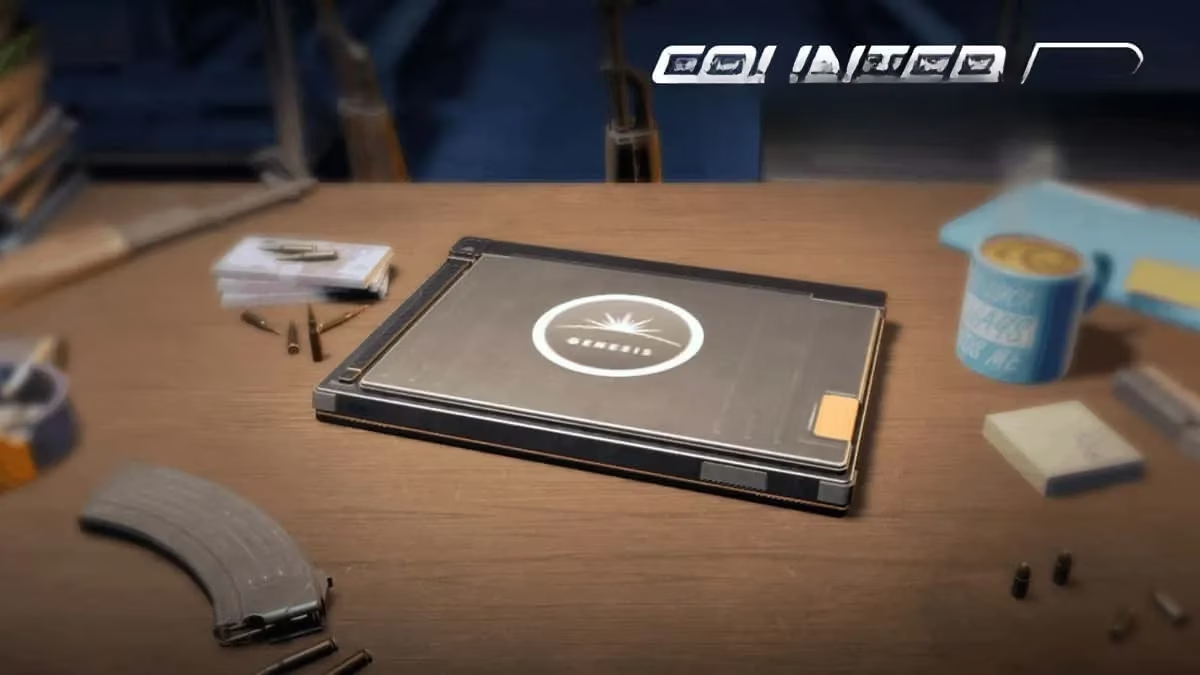
Ever since weapon finishes became tradable commodities, Counter-Strike has been synonymous with digital bling. Veteran players know the drill: open a case, cross your fingers, and hope for a Factory New knife or a StatTrak™ red. Streamers built entire careers on case-opening marathons, and the secondary market flourished with prices sometimes rivaling small used cars. Genesis Terminals change that tried-and-true formula by eliminating the random draw from dozens of common mil-spec items. Instead, you’re presented with a curated selection of five skins, but there’s a catch—you can only see them one at a time, and each reveal comes with the risk of losing what’s in front of you.
The mechanism is comfortingly simple yet diabolically tense. When a Genesis Terminal materializes in your inventory (reportedly as a free drop once per week), you “unseal” it at no cost. Immediately, the first skin appears. Here’s where the Deal or No Deal comparison becomes impossible to ignore. You must either accept that skin and pay its listed price, or reject it to move on to the next unseen option. Reject one, and it’s gone forever; there’s no cycling back. This creates a deliciously stressful decision tree that has Reddit threads buzzing with memes about offering a $3,000 AK-47 and risk-averse players agonizing over whether to take a decent but not mind-blowing skin or gamble on something spectacular behind curtain number two.
The community has been quick to draw parallels with Valorant’s Night Market, another Riot Games innovation that randomizes a handful of discounted skins and lets you buy them outright. Both systems aim to bypass the pure gambling mechanics of loot boxes while still feeding the desire for exclusive cosmetics. However, the Genesis Terminal diverges sharply in its execution. Valorant’s Night Market is passive—you open it, see six offers, and decide without any pressure to discard something first. CS2’s version flips that on its head by making rejection itself a strategic gamble. Fans of the long-running TV show Deal or No Deal instantly recognized the psychological hook: do you settle for the banker’s offer (the current skin) or open the next case hoping for the million-dollar item? The difference here is that the “banker” is Valve’s pricing algorithm, and some of the offers are genuinely eye-watering.
Speaking of prices, they aren’t for the faint of heart. Leaks and early reports from the September 2025 rollout showed some astonishing figures. A StatTrak™ Minimal Wear “Full Throttle” M4A4 carried a price tag around $525, while a Factory New variant of the same skin shot up to a staggering $1,500. An “Oligarch” AK-47 in Factory New condition was reportedly spotted at $370. These aren’t suggested bids on the Steam Market; they’re direct purchase prices from the terminal. It’s a stark departure from the case-opening economy, where you might spend $2.50 on a key and potentially land a knife worth thousands. Here you know the cost upfront—what’s unknown is whether you can stomach the price for the skin you’ve got, or whether you’ll push your luck and maybe end up with a dud or, worse, a skin that costs even more but you don’t love.
Aesthetic comparisons have also flown back and forth between the two rival tactical shooters. The aforementioned “Oligarch” AK-47 skin bears an uncanny resemblance to Valorant’s “Sentinels of Light” Vandal, with its radiant gold filigree and white-and-gold palette. It’s not a direct copy, but the thematic overlap is unmistakable, which has fueled plenty of lighthearted jabs and “living rent-free” jokes on social media. The newly added skin collection, which arrived alongside the Genesis Terminal feature, contains 17 total weapon finishes, many of them flaunting the sort of opulent, fantasy-inspired designs that could slot right into a Vandal or Phantom lineup. This crossover appeal is likely intentional, as developers on both sides keep a close eye on what drives cosmetic engagement.
Beyond the terminal itself, the September 2025 update packed in several other notable improvements that are still reverberating through the CS2 experience in 2026. Every grenade type—HE, flashbang, smoke, molotov, and decoy—received unique higher-fidelity sound effects for drawing, inspecting, pulling the pin, and throwing. This isn’t just an audiophile’s delight; it’s a tangible gameplay clarity boost, allowing players to identify the exact grenade an opponent is preparing through sound alone without relying on visual cues. Competitive players on Twitter (now X) praised the change as yet another step toward the “clarity” Valve promised with the Source 2 transition.
Subtick shooting consistency also got another round of improvements. If you’ve followed the CS2 saga since its 2023 launch, you’ll recall the heated debates about “dying behind walls” and shots not registering smoothly. The September 2025 update refined the subtick architecture further, reducing instances where the client and server disagreed on when a shot was fired. While no networking model can be 100% perfect, these tweaks combined with server-side optimizations from earlier patches have led many pro players to declare the hit registration “the best it’s ever been” heading into the 2026 Major season.
Perhaps the most under-the-radar yet significant addition was the introduction of cs_script, a JavaScript-based scripting framework for CS2 maps. Community cartographers and modders had been clamoring for more robust tools since the move to Source 2, and cs_script unlocks complex interactive elements—think dynamic lighting that reacts to rounds, custom objective logic beyond bomb defusal, and even minigame-style events within custom maps. By 2026, we’ve already seen surf and bhop maps with integrated stat tracking, co-op “zombie escape” modes with branching paths triggered by player actions, and aim training maps that adapt to your performance using scripts. This feature alone could extend the game’s longevity as much as any skin economy.
So, what does all this mean for the average CS2 player in 2026? For starters, the Genesis Terminal has added a weekly ritual akin to “skin lottery day.” Friends jump into Discord voice chats, share their screens, and act as backseat advisors while someone debates whether to reject an MP9 with a silly sticker on it. The “Deal or No Deal” gamble has even spawned streamer events where entire Twitch chats vote on whether to accept or reject, turning a solo decision into a communal experience. On the flip side, some purists worry that the terminal injects a pay-to-flex dynamic that could tilt the cosmetic landscape away from the thrill of random case openings. However, since the terminals are free to unseal and only appear once a week, they feel more like a bonus than a replacement.
In true Valve fashion, the Genesis Terminal and companion update have given the community plenty to chew on—a blend of high-risk shopping psychology, esports-viable audio upgrades, and generous scripting tools for the modding scene. Whether you’re the type who slams the “reject” button without a second thought or the one who nervously hovers over it for five minutes, the terminal has undeniably made skin hunting in CS2 more cinematic. And in a game where every round can feel like a high-stakes gamble, it’s only fitting that getting your dream finish now comes with its own nail-biting minigame.
| Feature | Genesis Terminal (CS2) | Valorant Night Market |
|---|---|---|
| Frequency | Once per week (free unseal) | Once per act (random) |
| Selection Style | Sequential, must reject to see next | All six offers visible at once |
| Pricing | Fixed, often high (e.g., $370–$1500) | Discounted from standard price |
| Gambling Element | “Deal or No Deal” style risk/reward | No risk; choose any or none |
| Skin Variety | 17 skins from new collection | Rotating pool from past bundles |
Valve’s willingness to experiment with cosmetic distribution, while simultaneously polishing gameplay and empowering map creators, suggests that CS2 is evolving beyond a simple hardcore shooter. It’s becoming a platform where fashion, risk, and community creativity collide. So the next time you see that glowing Genesis Terminal appear, take a deep breath, channel your inner game-show contestant, and ask yourself: do you have what it takes to beat the bank?